|
|
|
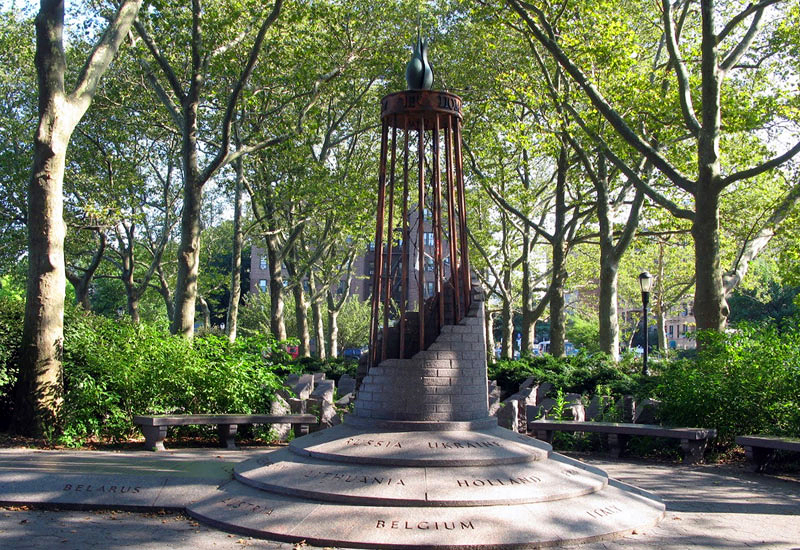
The Holocaust Inscription on Central MemorialThe Holocaust was the systematic, bureaucratic annihilation of six million Jews by the Nazi regime of the Third Reich and its collaborators during World War II. The German Third Reich, a vast empire of murder, pillage and exploitation, attached virtually every country in Europe . The toll in lives was enormous. In 1933, approximately nine million Jews lived in the 21 countries of Europe that would be occupied by Germany during the war. By 1945, two out of every three European Jews had been killed, including 1.5 million Jewish children. In Eastern Europe , the Jewish death toll was ninety percent.
As the Nazi tyranny under Adolf Hitler spread across Europe from 1933 to 1945, millions of innocent non-Jewish people were persecuted and murdered as well. Caught up in the Nazi slaughter were more than 200,000 gypsies (Roma and Sinti) and about 200,000 mentally or physically disabled persons. More than three million Soviet prisoners of war were killed because of their nationality. Poles as well as other Slavs were targeted for slave labor, and as a result tens of thousands perished. Homosexuals and others deemed "anti-social" were persecuted and often murdered. In addition, thousands of political and religious dissidents, such as Communists, Socialists, trade unionists and Jehovah’s witnesses, were persecuted for their beliefs and behavior: many of these individuals died as a result of maltreatment. The concentration camp is the most enduring symbol of the Holocaust. The first camps opened soon after the Nazis took power in January 1933, and continued to operate until May 8, 1945 , when World War II, and the Nazi regime, ended. During the war, ghettos, transit camps and forced-labor camps, in addition to concentration camps, were created by the Germans and their collaborators to imprison Jews, gypsies and other victims of racial and ethnic hatred, as well as political opponents and resistance fighters. Following the invasion of Poland , three million Polish Jews were forced into ghettos. After Hitler launched an attack on the Soviet Union in June 1941, the methodical murder process began with the machine-gunning of Jews by four Einsatzgruppen squads. Between 1942 and 1944, the Germans moved to eliminate the ghettos in occupied Poland and elsewhere, deporting ghetto residents to "extermination camps death centers" equipped with gassing facilities, in Poland . After the meeting of senior German government officials in late January 1942 at Wannsee, a Berlin suburb, the decision to implement "the final solution of the Jewish question" became formal state policy: all European Jews were marked for death. Six killing sites were chosen in Poland because of their proximity to railway lines and their location in semi-rural areas: Chelmno, Belzec, Sobibor, Treblinka, Majdanek, and Auschwitz-Birkenau. Chelmno was the first camp in which mass executions were carried out by gas. Between December 1941 and July 1944, more than 320,000 people were killed at Chelmno. The death tolls for the other killing centers: Belzec - 600,000; Sobibor - 200,000; Treblinka - 850,000; Majdanek - 275,000; and Auschwitz-Birkenau - 1,250,000. The largest single mass deportation during the Holocaust occurred between May 14 and July 8, 1944 , when 437,402 Hungarian Jews were deported to Auschwitz-Birkenau in 147 transports, consisting of hundreds of sealed freight cars. After an experimental gassing in September 1941, mass murder had become a daily routine. Nine out of ten people killed an Auschwitz were Jews. |
 The Holocaust